What you missed in April -Judith Proctor
The audience at the April u3a meeting was transported on a journey around England and briefly to New York when Peter Mathers was the guest speaker, entertaining us with a talk on “Municipal Marvels” – the rise and fall of public parks. He spoke about the history and development of the public park starting with his own experience in Bradford where his parents ran a corner shop which had only a back yard so a trip to the local park was a means of seeing some greenery and in the autumn, he enjoyed jumping into large piles of crunchy autumn leaves there.
All towns have large parks which are free to enter and provide amenities and health benefits to residents often to people who do not have access to a garden. The first public park in the world was opened in 1847, in Victorian times, in Birkenhead after a large explosion of population in the Industrial Revolution. This was considered Victorian one up man ship by the Local Authority and so was followed closely by a new public park in Liverpool. Sefton Park was designed by the gardener at Chatsworth House, Joseph Paxton, who also rescued the Great Exhibition. He was paid £800 (equivalent of £65,000 today) to design Sefton Park and this became the template for many future designs and parks. Frederick Law Olmstead visited for ideas, and he went on to design Central Park in New York.
The public park in York is a microcosm of the history of Roman and Ecclesiastical York, being run initially by the Yorkshire Philosophical Society until 1961 when it became the property of the citizens of York. Known as the Museum Gardens they were laid out in the mid-19th Century with year-round interest and a philosophical and scientific bias, with an accurate time clock.
Peter related information about more local parks such as Pocklington’s Burnby Hall Gardens and the water lilies collected by Major Percy Stewart and planted on 2 artificial lakes. Hull has 2 public parks - Pearson Park with its connection to Philip Larkin the poet who had a flat overlooking the park. This park opened in August 1860 and had 30,000 visitors on the first day. Money to build this park was donated by an entrepreneur, Zachariah Charles Pearson an importer of cotton, who was a Councillor and Lord Mayor. The second park was Queens Gardens built in 1930 which houses a statue of Sir William Wilberforce.
In 1934 Sewerby Hall was sold to the corporation and the gardens re-opened by Amy Johnson in 1936 with many specimen trees, a walled garden and typical local authority planting in blocks. Holland Park in London, privately owned initially but in the 1950s was sold to London County Council and has an impressive display of dahlias imported from Spain and a Japanese Garden looking more naturalistic. Spa towns are linked to beautiful public gardens as are the gardens in Harrogate. Something different was the 1993 linear park in Paris echoed by the second one built on an old railway line in New York. The third linear park was built in Manchester, the Castlefield Viaduct owned by the National Trust, where a wildlife garden is being developed and measures 330 metres long costing £2.4m.
This talk evolved into a really interesting afternoon’s entertainment with lots of ideas for people to visit during the warm summer months.
What you missed in May -Judith Proctor
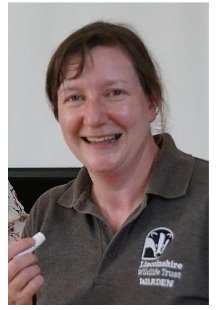
About 80 people were present for the talk given by Ruth Taylor
from Lincolnshire Wildlife Trust on the Grey Seal Colony at Donna
Nook. Ruth gave the audience a review of the conditions at Donna
Nook and the lifecycle of the grey seal with additional interesting
information on visiting arrangements.
The base for the colony is at Saltfleetby St. Clement where two
people manage the colony. Donna Nook has been an active RAF
weapons range since 1973, previously being an active MOD
airfield from 1927 to 1945. The National Nature Reserve was
established in 1972 and has a symbiotic relationship with the RAF
Weapons Range.
The Reserve has mixed habitats for nature, those being meadows,
salt marsh, beach area, shingle ridges and the Humber Coastal area. There are five different
species of orchid, birds foot trefoil, purple sea lavender, pebbles and driftwood and nesting
birds such as plovers. The grey seals are situated on the shoreline of the river.
There are some problems at the Reserve with litter, even large items such as chairs, parts
of cars, fridges. Rope is a particular problem, and seals have been found with this wrapped
around their necks. These seals are treated and nursed back to health at the Mablethorpe
Seal Sanctuary.
Seals spend two thirds of their life at sea and arrive at Donna Nook in the winter months to
breed. Bulls arrive first each weighing about 50 stone, large, dark with pale patches and a
wrinkled neck. The cows then arrive who weigh about 30 stone. They have about six
centimetres of thick blubber over their bodies. Grey seals are Britain’s largest mammal. The
males have harems and mate with as many females as possible after doing a bit of body
slapping and fighting for supremacy. Females will have a pup every year at the same place
for about 30 years. Gestation period is about 8 months. Females are in labour for about 2
minutes, getting fidgety and bouncing their back end to help pups to birth. Cows recognise
their pup by sniffing, so it is important for visitors not to stroke a pup. Pups are usually about
14 Kgs, and they sneeze to clear their airways then they find their voice which sounds like
they are shouting “Mum”. White and fluffy at first, they are weaned from mothers very rich
milk at about 18 to 21 days. Pups feed as many times a day as the cows will allow and cows
lose 40% of bodyweight whilst feeding. The cows then move out to sea and the pups lose
their fluffy coats and form creches together. After about 5 weeks they enter the sea for the
first time. Then their diet becomes cod, haddock, sand eels etc.
At the 29th November 2025 seal count the colony had 478 bulls, 1359 cows and 1815 pups.
The last pup born in 2025 was on 18 December. The colony has grown and now has about
40% of the British seal population. Their predators include the Orca in Scotland and visitors
to the colony are asked not to bring dogs because of diseases. During the birthing season
in 2025 there were 49,895 visitors, the highest weekend total was 5409 the highest weekly
total was 8796. This necessitates traffic management and car parking on farmer’s land.
There are 67 volunteers at the colony and 2673 hours of assistance are needed. Ruth’s talk
was totally absorbing with lots of interesting facts. We finished by showing our appreciation
by donating in the Lincolnshire Wildlife collection tin.
What you missed in June -Judith Proctor
Entertaining Scunthorpe u3a for the June 2026 monthly meeting was Mark Jessop with
a talk on “Weather Folklore”. Mark travelled from Hull and has worked as an Assistant
Scientific Officer for the Meteorological Office and also lectures to RAF pilots in training.
He also served in the RAF at various stations including RAF Leeming and RAF Church
Fenton.
He told the audience that he did a lot of observing the sky. A useful tool in forecasting is
the weather book in which anything out of the ordinary or facts about the station are
recorded. Mark told us about Admiral Robert Fitzroy who commanded HMS Beagle
through Cape Horn and introduced the Beaufort Scale (Windscale), the Fitzroy
Barometer and a storm warning method which was in use until 1970. Fitzroy became
the first Head of the Meteorology Office in 1854 and he made the first forecasts and set
the rules for forecasting. Politically, Fitzroy was the Governor of New Zealand.
Forecasting had to be written in the way people could understand, and many people
relied on forecasting hence the invention of various sayings to forecast weather. A very
familiar one being “Red sky at night shepherds delight red sky in the morning
shepherds take warning”. “Mare’s tails and mackerel scales make tall ships take in
their sails” is observed before a storm moves in. “Clear Moon, frost soon” is short term
forecasting. When there is a halo around the sun or moon it means there will be rain
or snow soon. Mark told us that a rainbow can be predicted when the sun is behind
and rain in front. There are many sayings attributed to the Victorian age and to nature-
based occurrences.
Mark informed us that most of our weather comes from the west over the seas. A rain
belt is generally 100 miles wide and travels at 25 miles per hour which proves the saying
“Rain before seven, fine by eleven,” which Mark uses all the time. Weather forecasting
is based on maths and meteorology with electronic input, sometimes lacking a
connection with the world around us. Looking at the sky is important in forecasting. A
blurry sun called a “wet sun” is a sign of rain.
Mark gave us some ideas of tools used for long range forecasting. On Groundhog Day
(2nd February) if you see a shadow winter weather will return if no shadow then it will be
spring weather. St Swithin’s Day (15th July) if there is rain or sun then the weather will
be the same for 40 days, not entirely proven. Tools for short range forecasting include
pinecones – moisture closes the cone to protect the seeds, seaweed, weather stick (dry
willow), weather rock and the best hygrometer is human hair. He also forecasts using
nature.
Mark finished by quoting Admiral Fitzroy “The problem with the weather is that the only
certain thing about it is its unpredictability” (1860). Interestingly Mark illustrated the fact
that so called “old wives’ tales” certainly has a place in predicting and forecasting the weather
What you missed in July -Judith Proctor
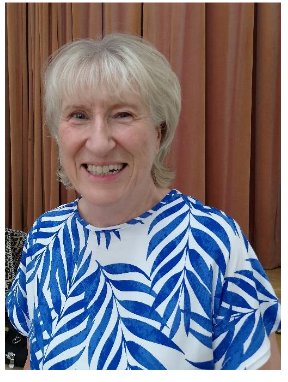
Joy Wood from Cleethorpes was the guest speaker for the u3a July meeting.
Her talk was entitled “From Bedpan to Pen”. Joy was guided and enthused by
her Father’s mantra, “Work hard and you will be
successful, be the best nurse you can be, listen
and learn. Turn up, shut up or if in doubt make it
up”. He encouraged her to be a “Rolls Royce
Nurse”. Joy talked about her journey as a nurse
and also about her writing career. She felt she had
had a wonderful career in the NHS starting in 1977
training in the Harlow Wood Orthopaedic Hospital
at Nottingham and then onto general nursing
training at Sheffield. The wards were the more
traditional nightingale ones with a Matron. After 2
years Joy took a written examination and an oral
examination. During her nursing career she also
went back to Cleethorpes to nurse her mother.
At the age of 40 her nursing career took a turn, and she worked in Public Health
as a school nurse during school term times. She made presentations to
schools and moved on to take a teaching course at Hull gaining counselling
skills. Her next venture was to set up a clinic in Lincoln for contraception, then
moving onto a teenage clinic after a course in sex and relationships at Sleaford.
She then took a Team Leader course at Hull University which enabled her to
get a job in the Children’s Family Services in Lincolnshire. During this time, she
undertook a degree course at Sheffield Hallam University. She worked more
in the administrative side at this point in her nursing career and she was offered
redundancy which was the catalyst for her to become a writer. Her first book’s
working title was “Iron Fist in a Velvet Glove” and took a year to write. She
found an editor online who checked after 3 chapters how things were going,
who advised a change of title as the book was about twins to “For the love of
Emily”. She was advised to spice the book up a bit. It cost £700 to complete.
To promote her self-published book Joy had articles in the local gazette and
book signings in a café in Keelby and in Waterstones and the House of Fraser.
She started giving presentations to raise her profile. The book that “put her on
the map” was “Hospital Murder” which was featured in the Wetherspoon’s
magazine. Joy was subsequently nominated for an award in the Romantic
Novelist genre.
Those wanting to know more about Joy should read “Dead Pretty” her book
based on herself. Joy concluded by reading out a poignant poem which had
been discovered in an old lady’s locker at the hospital.
What you missed in August - Eleanor Wasley
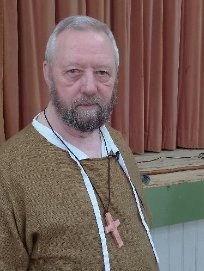
At the August meeting, Tony Pearson took us on a Medieval
Pilgrimage. He came dressed as a Medieval pilgrim along with
some of the possessions he would have taken with him. This
included a sturdy staff made of rowan and two small rowan
branches tied together with red thread to form a cross. Rowan was
believed to possess powerful protection against evil spirits
including elves, fairies and bogarts.
Going on pilgrimage was a serious business as the pilgrim had
to get permission not only from their bishop to go but also from the
king if they if they were travelling abroad. This proved they were
genuine pilgrims.
The pilgrims wore distinctive dress making them immediately
identifiable as a pilgrim. This was a woollen tunic over a linen shirt
that could be washed. Over this a woollen cloak which protected them against the weather
and especially rain. It could also provide a tent-like shelter at night. They wore a broad
brimmed hat adorned with distinctive pewter badges bought as souvenirs from shrines and
holy places, and worn over a simple linen coif. In cold or wet weather, this would be replaced
by a liripipe hood with a long ‘tail’ that could be wrapped round the neck to secure it. They
had a small leather pouch hanging from the belt to carry food or money as well as a small
water bottle.
Pilgrims often put mugwort in their shoes which helped prevent tired feet and muscle
cramps. Modern research shows this has antiseptic and antifungal properties too!
Many wore ‘anti-flea’ devices round their necks. These were often little skull shaped
containers that could be stuffed with sheep’s fleece. A drop of blood and honey was added
to the fleece. The fleas were attracted by the smell of blood and then got stuck in the honey.
The fleece and fleas could be discarded and replaced by clean fleece. It didn’t free the
pilgrim of fleas but did probably help control them...
Depending on where they were going, pilgrimages could take months if not years so it was
important someone reliable was looking after their property while away. It was also
dangerous. Not only were they exposed to the weather, dangerous terrain, wild animals and
disease, there was also the threat of pirates and bandits who would ambush them for their
money.
So why did they go? There were a variety of reasons from fulfilling a vow to God or a saint
at a time of crisis, atonement for sins and to reduce time spent in purgatory or to ask for a
miracle or cure, either for themselves or close family. Some just went for adventure and to
see and touch revered relics.
Local merchants cashed on to this and sold a variety of small body parts made from wax
that could be left at the shrine with prayers for healing... These were then collected and
recycled to sell again. Pilgrims could also buy a small mirror in a pouch which they could
expose at the shrine and then take home the healing powers.
The sale of ‘relics’ was also big business. Pilgrims could buy a vial with a drop if the blood
of Thomas Becket, part of the arrow shaft that pierced St Edmund, a shoe nail from St
George’s horse that he rode to kill the dragon. You could even buy a finger bone from St
Werburgh. Pilgrimage was also big business for the church who collected large sums of
money from the pilgrims.
And another entertaining afternoon